 Fulfillment< @ >HQ Group

Q4 is one of the busiest periods of the year for ecommerce brands. As Halloween, Thanksgiving, Black Friday, Cyber Monday, and Christmas approach, Shopify sellers need to think beyond product sourcing and sales campaigns.
They also need to answer an important question:
Which shipping route can get products from China to US customers at the right balance of cost, speed, and reliability?
Choose a route that is too slow, and your products may arrive after the peak shopping window. Choose an unnecessarily expensive option, and shipping costs can eat into your margins. Send inventory too late, and even a successful marketing campaign may turn into a stockout problem.
There is no single shipping route that works best for every product or order.
The right choice depends on your delivery deadline, product characteristics, shipment size, inventory strategy, and budget.
In this guide, we'll explain the main China-to-US shipping options, when each one makes sense, and how Shopify sellers can prepare a more flexible shipping strategy for Q4.
During regular sales periods, a few extra days in transit may be manageable. During Q4, timing becomes much more important.
Customers may be purchasing gifts for a specific occasion. Promotions can create sudden order spikes. Carriers and fulfillment providers may experience higher volumes, while suppliers may need more time to replenish popular products.
A shipping strategy that works well in September may not be sufficient for a major holiday campaign.
For Shopify sellers, shipping decisions can affect several parts of the business:
Delivery speed | Total fulfillment cost | Inventory availability | Customer satisfaction | Promotional planning | Profit margins
The key is to choose a route based on the order's actual requirements—not simply the lowest quoted shipping price.
Express shipping is worth considering when orders have tight deadlines or products need to reach customers quickly.
It may be suitable for urgent replenishment, samples, high-priority orders, or smaller shipments where delivery speed matters more than the lowest transportation cost.
Consider express services when you need to send product samples, replenish a fast-selling SKU, or move a limited quantity of inventory to avoid a potential stockout.
However, express shipping can cost more per unit than slower transportation methods. It may not be the most economical choice for large shipments of products with predictable demand.
Best for:
Urgent shipments, samples, and time-sensitive replenishment.
Before booking:
Confirm the current transit estimate, cutoff time, destination coverage, product eligibility, and any additional handling or customs requirements.
Air freight can be a practical option when you need to move inventory in bulk from China to the US but cannot wait for ocean freight.
Unlike shipping individual customer orders internationally, air freight can move a batch of inventory to a US warehouse or fulfillment center. Orders can then be dispatched domestically after the goods have arrived and been received into inventory.
A typical workflow looks like this:
China Supplier → Quality Inspection → Air Freight → US Warehouse → Domestic Fulfillment → Customer
This model can be useful for proven products with growing demand, particularly when the remaining time before a sales peak is limited.
Air freight costs depend on factors such as chargeable weight, dimensions, route, service level, and product type. Bulky products may be expensive to transport by air even when their actual weight is relatively low.
You should also allow time for export processing, customs clearance, delivery to the warehouse, and warehouse receiving. The quoted flight or transit time is not necessarily the total time until inventory becomes available for sale.
Best for:
Replenishing proven bestsellers, moving medium-sized inventory batches, and preparing stock for a nearby sales deadline.
Ocean freight is often worth evaluating for larger inventory shipments when there is enough time before the goods are needed.
It can be suitable for products with predictable demand, planned seasonal campaigns, or inventory that will be stored in a US warehouse before orders begin to surge.
A typical process is:
China Supplier → Consolidation → Ocean Freight → US Customs Clearance → Warehouse Receiving → Fulfillment
Ocean shipments require more than the time spent at sea. Export handling, port operations, customs clearance, inland transportation, and warehouse receiving all contribute to the overall lead time.
For Q4, sellers should work backward from the date inventory needs to be available in the warehouse—not simply from the date the ship is expected to arrive.
Ocean freight may also involve different options, including full container load (FCL) and less-than-container load (LCL). The more suitable choice depends on shipment volume, cargo characteristics, handling requirements, and total landed cost.
Best for:
Larger inventory batches, planned replenishment, and products with enough lead time before peak demand.
Choosing a transportation method is only part of the decision. You also need to decide where the goods should go.
For many Shopify sellers, the choice is between shipping individual orders from China and sending inventory in bulk to a US warehouse.
Customer Order → China Fulfillment Center → International Shipping → US Customer
This approach can reduce the need to hold large quantities of inventory overseas. It may be useful for new products, low-volume SKUs, and products whose demand is still uncertain.
However, each customer order must go through an international delivery process. Delivery times depend on the selected service, customs processing, destination, and carrier performance.
China Supplier → Bulk Shipment → US Warehouse → Domestic Shipping → Customer
With this model, inventory completes the international journey before the customer places an order. Once the products are received and available in the warehouse, individual orders can be fulfilled domestically.
Potential benefits include shorter domestic delivery distances, more predictable local fulfillment, and greater flexibility during sales spikes.
The trade-off is that sellers need to plan inventory in advance and account for inbound transportation, warehouse receiving, storage, and the risk of unsold stock.
| Business Situation | Model to Consider |
|---|---|
| Testing a new product | Direct shipping or a small initial inventory batch |
| Low-volume or unpredictable sales | Direct shipping may offer more flexibility |
| Proven US bestseller | Bulk shipment to a US warehouse |
| Preparing for a major promotion | Pre-positioned inventory with planned replenishment |
| Large shipment with a longer planning window | Evaluate ocean freight |
| Urgent inventory replenishment | Compare express shipping and air freight |
For many growing Shopify brands, a hybrid fulfillment strategy can provide the most flexibility: keep new and long-tail products in China while positioning proven bestsellers closer to US customers.
Not every product can use every shipping service. Product composition, dimensions, packaging, and carrier restrictions can affect route availability.
Before requesting a quote, identify what you are shipping.
Clothing, accessories, and many ordinary consumer products may have several shipping options. The best route depends on shipment size, urgency, and whether the goods are being sent to a warehouse or directly to customers.
Products containing batteries may be subject to specific packaging, documentation, and carrier requirements. Confirm that the proposed service accepts the exact product before arranging transportation.
Cosmetics, liquids, powders, magnetic products, and other regulated or restricted cargo may require a specialized service, depending on the product and destination.
Do not assume that a route accepting general merchandise will also accept every special-cargo product.
Always confirm product eligibility, packaging rules, documentation, and destination restrictions before shipping.
A low freight quote does not always mean a low total fulfillment cost.
Your shipping budget may need to account for:
Product cost
Export handling and transportation
International freight
Customs clearance, duties, and applicable taxes
Destination handling and inland delivery
Warehouse receiving and storage
Pick-and-pack fees
Final-mile delivery
Potential returns and reshipping
The exact cost structure depends on the shipping service, commercial terms, product, destination, and who is responsible for each charge.
For example, ocean freight may offer an attractive transportation rate for a large shipment, but it may not be the right option if inventory arrives too late to generate sales. Similarly, express shipping may cost more but help prevent a stockout of a proven bestseller.
The better comparison is:
Total Cost Per Delivered Order = All Relevant Product, Logistics, Fulfillment, and Delivery Costs ÷ Orders Delivered
Use this measure alongside delivery speed and reliability when comparing routes.
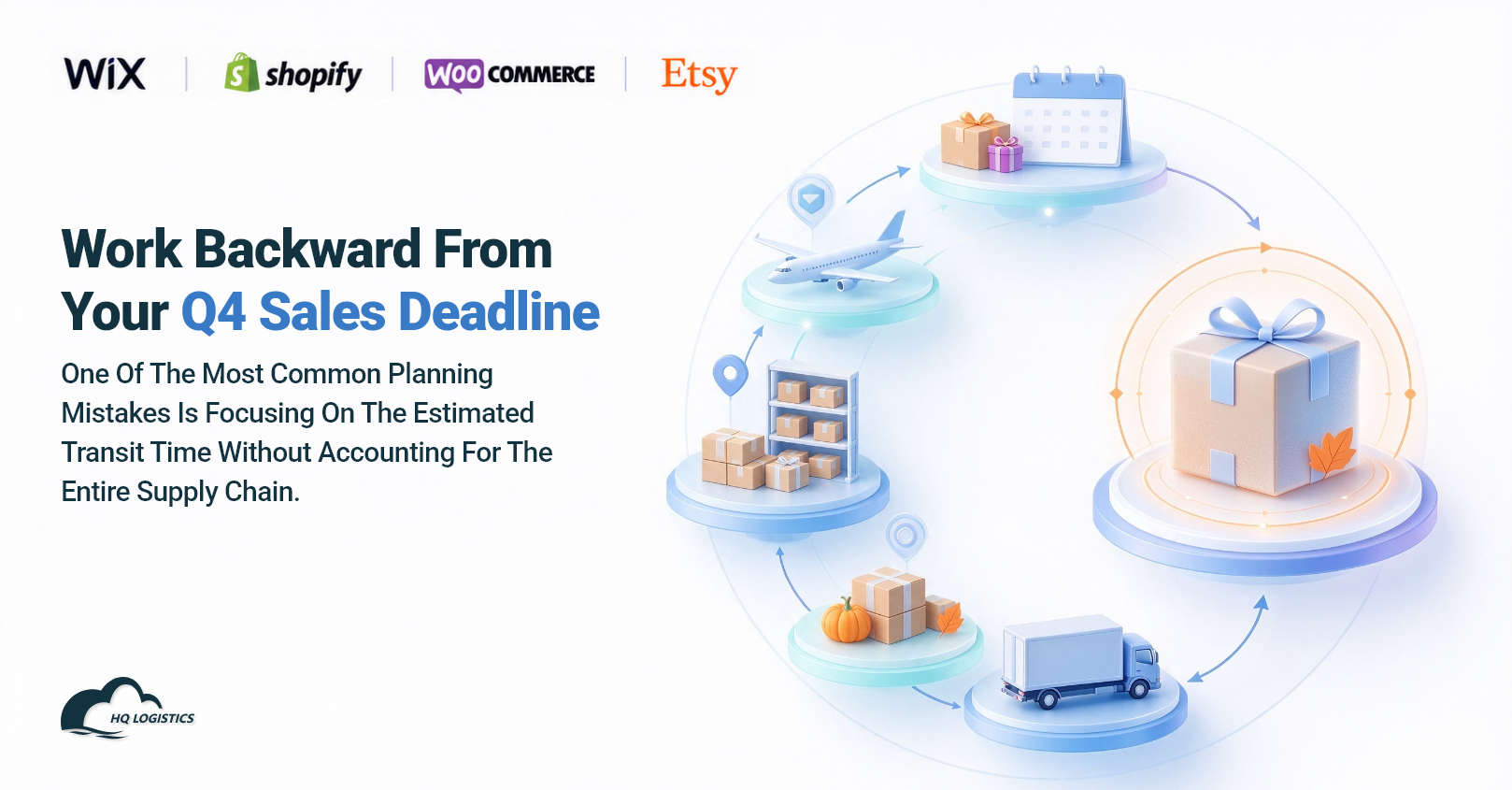
One of the most common planning mistakes is focusing on the estimated transit time without accounting for the entire supply chain.
Your timeline should include:
Supplier Production → Quality Inspection → Export Preparation → International Transit → Customs Clearance → US Transportation → Warehouse Receiving → Order Fulfillment
Each stage takes time, and some delays are outside your control.
Instead of asking, “How long does shipping take?” ask:
“When must my inventory be available for sale, and when do I need to ship it to meet that date?”
Build your plan around the expected warehouse-ready date, then leave a buffer for delays.
If you are preparing for a major Q4 promotion, confirm supplier capacity, warehouse receiving schedules, shipping cutoffs, and inventory allocation well in advance.
You do not need to send every product by the same route.
A more flexible plan can match each shipping method to a different inventory need.
Express Shipping:
Urgent samples or high-priority replenishment.
Air Freight:
Faster bulk replenishment for proven products.
Ocean Freight:
Larger planned inventory shipments when the timeline allows.
Direct Shipping From China:
New, low-volume, or long-tail products where holding overseas inventory may not be justified.
US Warehouse Fulfillment:
Proven bestsellers that need faster domestic delivery after inventory arrives.
This approach helps sellers balance speed, cost, and inventory risk instead of relying on one shipping method for every situation.
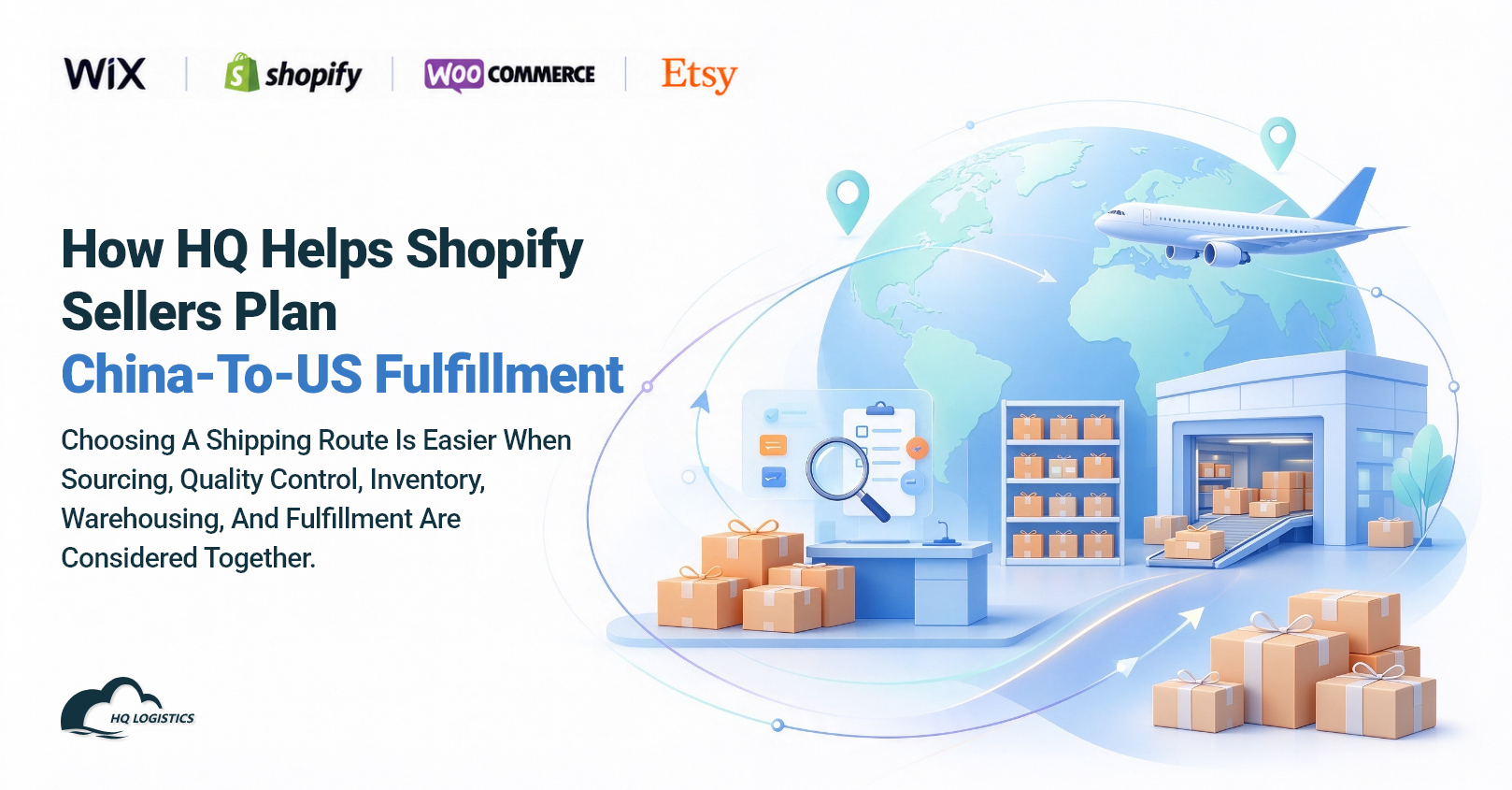
Choosing a shipping route is easier when sourcing, quality control, inventory, warehousing, and fulfillment are considered together.
HQ can support Shopify brands with product sourcing, supplier coordination, quality inspection, inventory consolidation, China warehousing, US overseas warehousing, custom packaging, Shopify order integration, order fulfillment, tracking synchronization, and global shipping solutions.
A connected workflow can look like:
China Sourcing → Quality Inspection → Route Selection → US Warehouse or Direct Shipping → Fulfillment → Tracking
The right setup depends on your products, shipment volume, sales forecast, target delivery dates, and budget. Rather than choosing a route based only on the freight rate, sellers should compare the full journey from supplier to customer.
For eligible products and services, HQ also offers two months of free US overseas warehouse storage. Eligibility and service conditions should be confirmed before shipping inventory.
If you are preparing for Q4, review your best-selling SKUs, expected order volume, and inventory position before deciding which products should ship directly and which should be stocked in the US.
There is no universally best route from China to the US for Q4 orders.
Express shipping may make sense for urgent shipments. Air freight can help replenish proven products when time is limited. Ocean freight may be suitable for larger planned shipments. Direct shipping can preserve flexibility for new products, while US warehousing can support faster domestic fulfillment for inventory that is already in stock.
The best strategy depends on how quickly you need the products, how much inventory you are moving, what you are shipping, and how much total fulfillment cost your margins can support.
Plan backward from your sales deadlines, confirm product eligibility, compare total landed costs, and build a buffer into your schedule.
Choose the right route. Position inventory wisely. Prepare your Q4 fulfillment before demand peaks.

There is no single best route. Express shipping may suit urgent orders, air freight can support faster bulk replenishment, and ocean freight may be appropriate for larger shipments with more lead time. The choice depends on your deadline, shipment size, product type, and budget.
Air freight is generally worth considering when inventory is needed sooner. Ocean freight may be more cost-effective for larger shipments when the schedule allows. Compare total landed cost and the date inventory will be available in the warehouse.
Direct shipping can suit new products and uncertain demand because it reduces the need to pre-position large amounts of inventory. A US warehouse can be useful for proven bestsellers and predictable demand because orders can be fulfilled domestically once inventory is received.
Work backward from the date inventory must be ready for sale. Include supplier production, inspection, export handling, international transit, customs clearance, domestic transportation, and warehouse receiving. Build in a buffer rather than relying only on the advertised transit time.
No. Batteries, cosmetics, liquids, powders, magnetic products, and other special cargo may have additional requirements or route restrictions. Confirm eligibility and documentation with your shipping provider before booking.
Compare the full cost structure, expected transit time, service scope, product eligibility, tracking, customs arrangements, destination coverage, and warehouse receiving requirements—not just the freight rate.
📩 Email: zoye@fulfillment-cn.com
Previous Recommendations


China to US shipping, China to USA shipping routes, best shipping method from China to US, Q4 shipping strategy, China to US air freight, China to US ocean freight, express shipping from China to USA, US warehouse fulfillment, Shopify shipping strategy, Q4 inventory planning, China fulfillment center, ecommerce shipping costs, international fulfillment, Shopify fulfillment partner




Don't wait until next year, grab the chance on 2025. Here are some recommended ecommerce topic you can choose.
Thanks to the support and trust from our customers. Flashback with our beloved partners.